
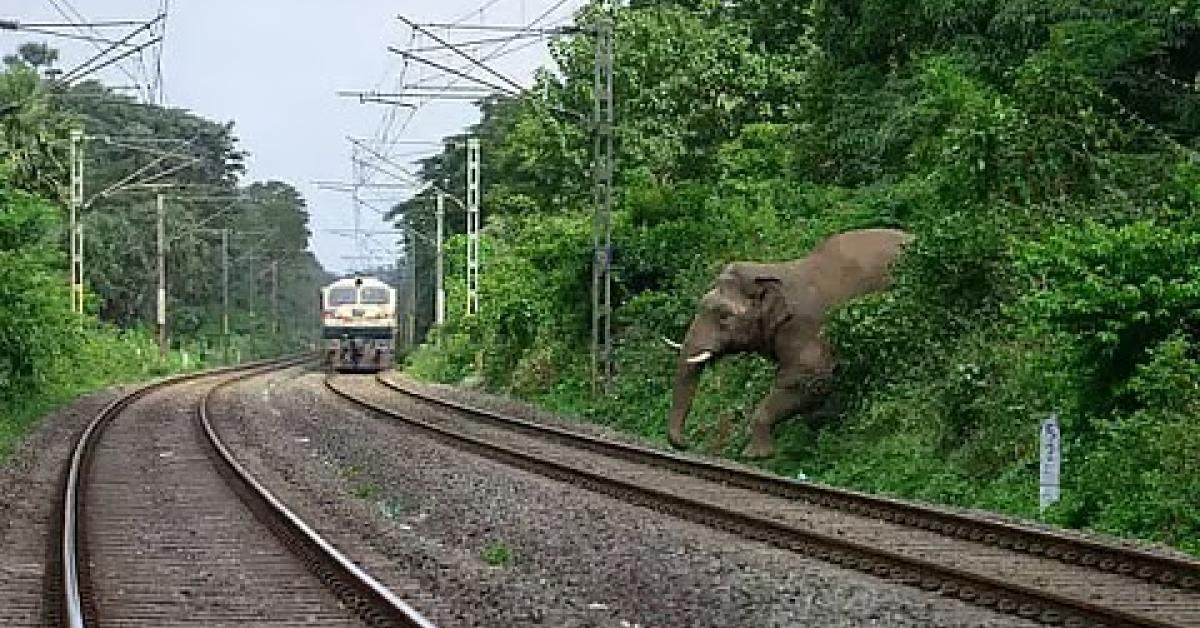

A tragic train accident involving a herd of wild elephants in Assam has once again exposed serious gaps in wildlife safety measures along railway lines that cut through forested landscapes, raising concerns over the impact of expanding infrastructure on fragile ecosystems.
The incident occurred in the early hours of Saturday when a high-speed passenger train struck a group of elephants crossing the tracks in Assam’s Hojai district. At least seven elephants, including calves, were killed on the spot, while another injured calf later succumbed during treatment, forest officials said. Several coaches of the train derailed following the collision, though no passengers were reported injured.
According to officials, the stretch of railway track where the accident took place passes close to forest areas frequently used by elephants for movement between feeding grounds. However, the area is not officially notified as an elephant corridor, resulting in limited protective measures such as permanent speed restrictions or animal detection systems.
The accident has drawn sharp reactions from wildlife experts and conservation groups, who argue that existing safeguards are inadequate in regions where rail lines intersect with known elephant habitats. They pointed out that advanced technologies such as intrusion detection systems, thermal sensors and real-time alerts for train drivers are either absent or inconsistently deployed across vulnerable stretches.
Forest department sources said visibility was poor at the time of the accident due to fog, reducing the crew’s ability to spot the herd in time. Railway authorities stated that an inquiry has been ordered to determine the sequence of events and to assess whether additional safety protocols could have prevented the collision.
Chief Minister Himanta Biswa Sarma described the incident as deeply distressing and said the state government would work with the Railways to strengthen coordination and implement stronger wildlife protection measures. “Such incidents underline the urgent need for technology-based solutions and better planning to safeguard both wildlife and human lives,” he said in a statement.
Data from the environment ministry indicate that dozens of elephants have died in train accidents across India in recent years, with Assam and other northeastern states emerging as major hotspots due to dense forests intersected by rail and road networks.
Conservationists have renewed calls for the formal identification and notification of elephant corridors, installation of early-warning systems, regulated train speeds at night, and greater coordination between forest and railway authorities. They warn that without sustained and long-term measures, conflicts between wildlife and infrastructure will continue to result in irreversible losses.
The Assam tragedy has once again highlighted the challenge of balancing rapid infrastructure development with the protection of endangered species in one of India’s most biodiverse regions.
- Log in to post comments